.png?width=1920&height=1080&name=CRARS%2026%20Article%20Why%20are%20your%20climate%20risk%20assessments%20%26%20asset%20decisions%20flawed%20(4).png)
Scope 3: From carbon accounting to actionable supplier engagement
Scope 3 emissions remain the hardest part of any organisation’s carbon footprint to influence, because most of that footprint sits with suppliers rather than under direct control. For procurement teams, the challenge has moved on from measurement and disclosure to a harder question: how do you turn supplier emissions data into real decisions, without overwhelming the suppliers you rely on?
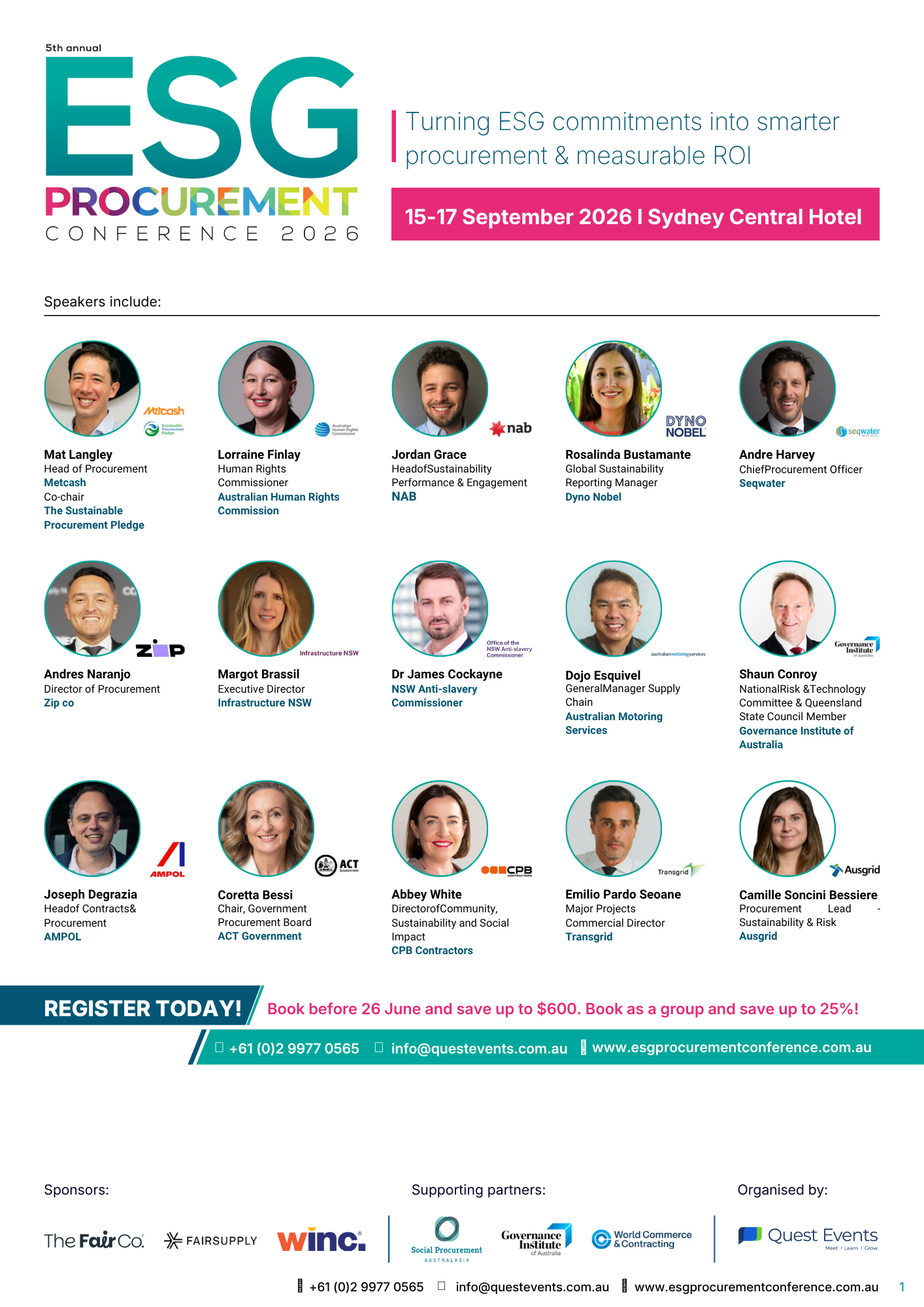
We put five questions to two subject-matter experts who will be speaking at ESG Procurement Conference 2026: Elodie Aime, Procurement Manager, Social Legacy at Transgrid, and Mat Langley, Head of Procurement at Metcash and Co-chair of The Sustainable Procurement Pledge.
1. Practically speaking, what does the shift from measuring Scope 3 emissions to acting on them look like in your organisation?
Elodie Aime believes that acting on Scope 3 starts with the choices made when selecting suppliers. “We're increasingly recognising suppliers with credible net zero plans through our tender evaluations and using procurement to drive the right behaviours.”
But the biggest shift, she explains, comes from recognising that decarbonisation is a shared challenge that no organisation can solve alone. “That's why we’ve brought key suppliers together through our ESG forum and established dedicated net zero working groups. These groups create a space to openly discuss challenges, share knowledge and co-design practical solutions to shape what decarbonisation across our supply chain looks like together.”
For Mat Langley, the shift starts when carbon data enters commercial and resilience decisions. “High-carbon hotspots often reveal energy, material or logistics inefficiencies, while also exposing suppliers and categories to rising energy and carbon prices, climate disruption and future regulation. Leading organisations connect those hotspots to category strategies, specifications, sourcing, contracts and supplier-development plans, then prioritise practical interventions.”
“The test”, he says, “is whether the insight changes a supplier conversation, investment, specification or award decision and improves both emissions performance and supply resilience.”
2. How do you get suppliers engaged on carbon data without adding so much reporting burden that it damages the relationship?
“Meet suppliers at their maturity level and give them the tools to take the next step”, advises Langley. “In APAC, many suppliers (especially SMEs) cannot begin with audit-ready footprints. Use a staged pathway: accept basic data for hotspotting, then support movement to activity data, attributable product or service footprints, and ultimately joint decarbonisation roadmaps. Provide simple templates, calculators, training and clear guidance; ask only for data tied to a decision; and return useful insight. Engagement works best when the buyer builds capability and commercial relevance, rather than imposing one questionnaire on everyone.”
“The first thing”, says Aime, “is that we're designing the process with suppliers, not for them. One of the working groups we’ve established is entirely focused on carbon measurement, so suppliers get to tell us what works and what doesn't. We're also conscious that many organisations are further along this journey than we are. Rather than creating another reporting system, we're looking at tools and approaches suppliers are already comfortable using and adapting them to a Transgrid context where possible.”
3. When supplier emissions data is incomplete or unverifiable, where do you draw the line between acting on it and waiting for better information?
In Langley’s view, the best approach is to use supplier maturity and decision consequence together. “At an early stage, spend data and transparent proxies can support hotspotting. The next step is hybrid activity data, then attributable product or service footprints as capability improves.” He recommends giving suppliers tools and a clear path upward rather than rejecting imperfect inputs. “Low-regret, reversible actions, like efficiency, waste reduction or pilots, can proceed with labelled assumptions and a measurement plan. Supplier comparisons, major awards and public claims require progressively stronger, comparable evidence. Act where the choice is reversible, and raise the assurance threshold as commercial or reputational consequence increases.”
Aime points out that we're never going to have perfect data, particularly in the early stages, so waiting for complete certainty isn't realistic. Her team’s approach, therefore, is to focus first on what’s material. “We’re not trying to measure everything from day one. Through one of our supplier working groups, we’re partnering with suppliers to identify the most credible data sources for the areas that matter most, both during design (when there's still a lot of uncertainty) and during delivery, when information becomes clearer.”
The key question, says Aime, is always whether the data is good enough to inform action.
“If not, what gaps need to be addressed? Ultimately, we don't want to spend more time measuring carbon than reducing it.”
4. Where have you seen decarbonisation initiatives run into cost or commercial pushback, and how was that resolved?
Still being in the early stages of its decarbonisation journey, Transgrid is not yet at the point of implementing large-scale solutions. Even so, Aime notes that questions about cost come up regularly, whether it's the cost of carbon measurement or lower-carbon alternatives.
“One thing we're trying to do is reframe carbon management as an efficiency tool rather than a compliance exercise”, she explains. “Understanding the materials that go into a project from design through to delivery is simply good project management, and many organisations have found cost savings through that visibility. That said, we shouldn't pretend every low-carbon option is commercially viable today. Organisations need to be clear about how they value carbon and what trade-offs they're prepared to make. For us, that's still a work in progress.”
In Langley’s experience, pushback grows when carbon is presented as an extra cost without a credible business case. His advice is to start by using decarbonisation action databases to match a supplier’s footprint, sector, geography and maturity with practical interventions, estimated abatement, cost and payback. Then, help the supplier build the internal case through efficiency savings, energy-price protection, resilience, customer demand and future compliance, supported by pilots, volume commitments or shared investment.
He notes that market capability remains uneven: “Few carbon-accounting providers also support supply-chain decarbonisation business cases, and supplier access to renewable-energy solutions is rarer still. Buyers must bridge that execution gap.”
5. What's one Scope 3 assumption the industry still gets wrong?
“A common assumption buyers make”, says Langley, “is that because they are ready to act on Scope 3, their suppliers are ready too. Many are not. Progress starts with spend-based hotspotting, but it cannot end there: buyers need a strong supplier-relationship program that builds capability, moves priority suppliers toward primary activity and product data, and turns evidence into decarbonisation initiatives.”
The readiness gap also exists inside the buyer. “Procurement, sustainability, finance, operations and business units (and sometimes clients) need enough education to understand the choices and trade-offs. Scope 3 is therefore an ecosystem-capability challenge, not simply a data exercise”, he notes.
“One assumption I think we still make is that Scope 3 is somehow separate from business as usual; a sustainability exercise that sits alongside everything else”, says Aime. “In reality, a lot of what we're talking about is simply good business practice. It’s understanding supply chains better, working more closely with suppliers, improving visibility of materials and finding more efficient ways of doing things. When it's approached that way, Scope 3 becomes less about reporting and more about driving innovation, collaboration and better decision-making. That’s where I think the biggest opportunities are.”
Continue the conversation
Hear more from Mat Langley, Elodie Aime and a line-up of other expert practitioners at ESG Procurement Conference 2026